
Written by: Ryan Dunlop, CEO and Founder of Full Arch Masters and graduate from the Harvard School of Dental Medicine
Key Takeaways
-
Dental implant CE for general dentists should be evaluated by whether it produces independent placement. Hours logged and certificates earned are secondary.
-
AGD PACE approval, live-patient hands-on training, post-course mentorship, team attendance, and cost-to-revenue analysis are the five non-negotiable criteria before enrolling.
-
Lecture-only and model-based formats build knowledge and familiarity. Live-patient surgical experience develops the judgment required for independent cases.
-
Proper CDT coding (D6010, D6056, D6057, D6080) and billing workflows determine whether adding implants improves a practice’s profitability.
-
Full Arch Masters delivers a complete implementation system that includes team training, 90-day post-course support, and a proven digital workflow that turns training into revenue.
See Full Arch Masters Course Dates
What To Verify Before You Pay: PACE Status, Format, Mentorship, Team, and Cost
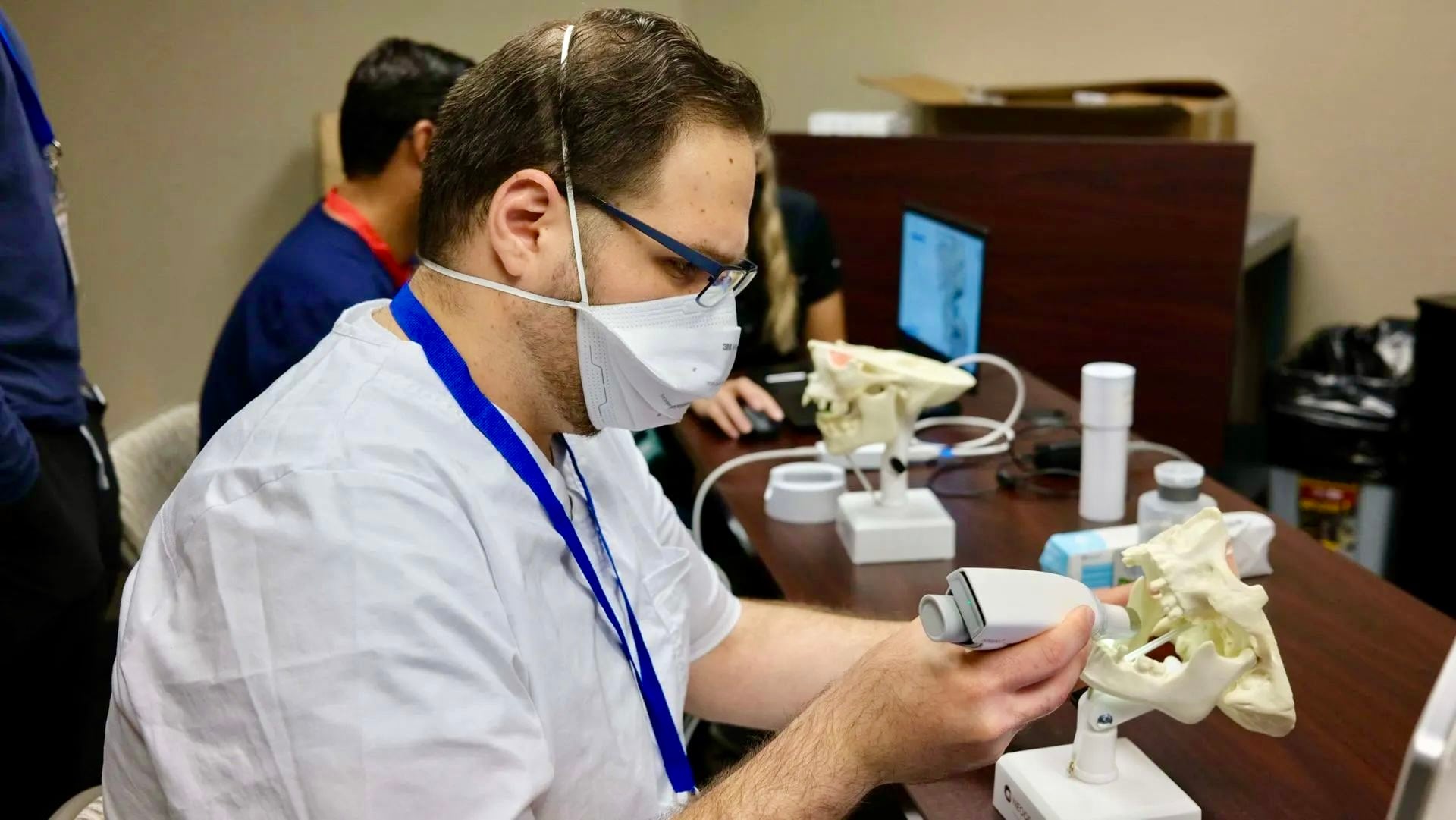
Dentists should verify five core criteria before committing to any implant CE program. These criteria separate training that changes a practice from training that does not.
-
AGD PACE Approval. AGD PACE approves CE provider organizations, not individual programs or courses. That distinction matters because a course marketed as “PACE-compliant” or “AGD-aligned” may not be offered by a PACE-approved provider at all. Every legitimate PACE provider appears in the AGD PACE provider directory with a six-digit ID and an expiration date. Look up the provider before paying. After you confirm PACE status, verify separately that your state dental board accepts those credits toward licensure renewal, because acceptance is state-specific and not guaranteed by PACE approval alone.
-
Live-Patient Hands-On Versus Model-Based Versus Lecture-Only. Training format is the decision that most directly affects whether a dentist leaves ready to place. Live-patient surgery requires a legal framework. Most states do not allow visiting dentists to operate on volunteer patients, and credentialing is typically handled in advance with the relevant state dental board. Ask how the program structures live-patient cases and how they handle credentialing before you register.
-
Post-Course Mentorship and First-Case Support. Effective post-course implant mentorship typically runs six to twelve months or longer and includes treatment-plan review, teledentistry consults, and in-office proctoring for the first few independent cases. Many dentists experience the same failure pattern. The course ends, they return to practice, and the first difficult case appears with no support structure behind it. A program that defines mentorship in writing reduces that risk.
-
Team Attendance. A dentist who returns from training alone struggles to operationalize a new workflow. The assistant, treatment coordinator, and lab technician need to understand the same system. A course that trains only the dentist produces a knowledge gap between the dentist and the team, which slows implementation.
-
Cost and Time Out of the Practice. Implant CE programs range from roughly $1,500 for 1–3 day weekend courses to $45,000+ for 12+ month mini-residencies, with continuums (6–18 months) costing $10,000–$30,000. Dentists should weigh both cost and time away from the chair against expected case volume and revenue impact, not against the course fee in isolation.
Choosing Training Format: Lecture, Models, and Live-Patient Surgery
Training format is the most consequential variable in implant CE, and many course pages hide it behind hour counts and credit totals.
Lecture-only CE builds knowledge. A dentist who completes a lecture-only implant course understands anatomy, treatment-planning principles, and implant system options. They still lack the procedural fluency to manage a real case. Didactic-only implant courses explain what implants are but do not prepare a dentist for a drill sequence that feels wrong mid-surgery or bone density that surprises them on the table.
Model-based training builds familiarity with instrumentation and sequence. Drilling on bone models, working through osteotomy sequences, and practicing flap design on simulation material all reduce the cognitive load of the first live case. A rigorous hands-on component covers drilling sequences on bone models, soft-tissue flap management, suturing, and basic bone grafting. Model-based work still stops short of the judgment demands a live patient introduces.
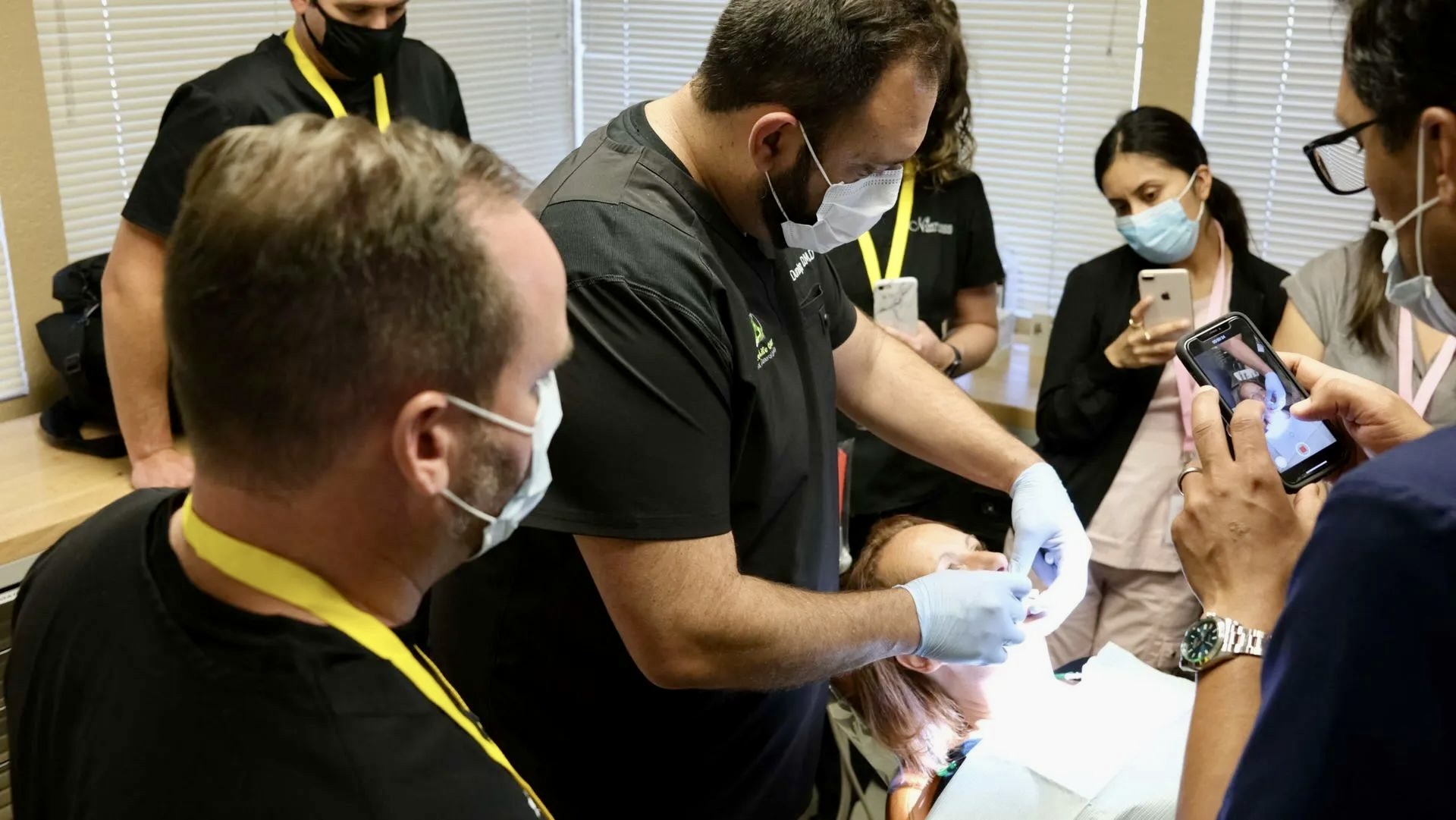
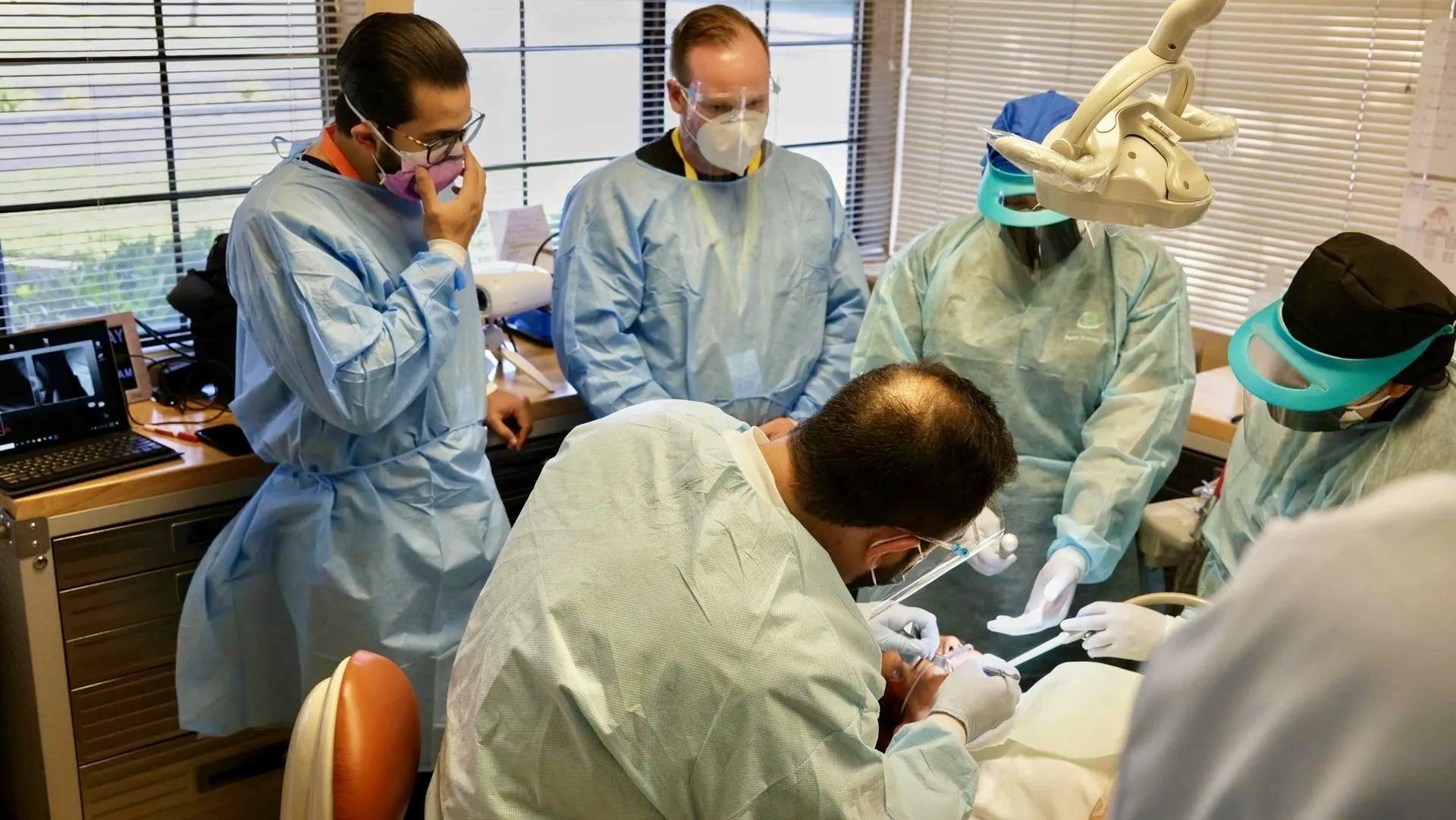
Live-patient hands-on training builds the judgment to manage a real case. Dentists practice flap design decisions, osteotomy execution, primary stability assessment, immediate load decisions, and complication management in real time. One-to-one mentorship during live surgery most directly transfers skill to independent practice. The progression from observe to assist to perform under supervision to perform independently is the sequence that produces competent placers.
The Business Layer: Implant CDT Coding and Billing Basics
Adding implant placement to a practice changes the billing profile of every case. The CDT coding cluster for implants trips up general dentists more consistently than the surgery itself, and coding errors directly affect whether implants improve the practice’s P&L.
D6050 — Implant Body (Endosteal Implant Placement). The surgical placement of the implant body is coded as D6010 in current CDT nomenclature. D6010 is the CDT code for surgical placement of an endosteal implant body, billed at the surgical visit. This code anchors the implant billing sequence, and every downstream code depends on this placement appearing in the patient’s claims history.
D6056 — Prefabricated Abutment (Includes Placement). D6056 covers a stock abutment selected from the implant manufacturer’s catalog, with any chairside trimming and the seating visit included in the single code. A stock abutment modified chairside still falls under D6056. The custom design must be on the abutment itself, not on the crown placed over it, to justify D6057.
D6057 — Custom Fabricated Abutment (Includes Placement). D6057 covers an abutment machined or printed to a patient-specific design from a digital scan or impression, with the abutment-seating appointment folded into the single code. The D6056 versus D6057 distinction is where general dentists adding implants most commonly make billing errors. Some dental plans apply an alternate-benefit clause that pays D6057 at the D6056 prefabricated allowable, and the patient owes the difference. Documenting the clinical rationale for custom fabrication, such as angulation correction, emergence profile, or esthetic-zone demands, supports the code on audit.
D6080 — Implant Maintenance. D6080 and D6081 are frequency-limited like prophylaxis, so practices must verify the interval rather than assuming it matches routine cleaning limits. Implant maintenance represents a recurring revenue line that many practices undercode or miss entirely.
The surgical component of implant placement may also have CPT coding applicability in specific reconstructive or medically necessary contexts. Medical crossover for implants is narrow and applies primarily to CPT 21248 and 21249 for reconstruction after trauma, oncologic resection, or congenital absence. These codes do not apply to elective replacement of a tooth lost to decay or periodontal disease. Dentists should confirm medical billing applicability with their own billing resource before submitting CPT claims.
Beyond the business layer, many general dentists pursue formal credentialing to strengthen their standing for hospital privileging and malpractice documentation. That pathway has its own requirements.
The Credentialing Pathway and the First 90 Days After the Course
General dentists who want a formal credentialing track have two primary verifiable references. The AAID Associate Fellow pathway requires over 300 hours of CE dedicated to implant dentistry, demonstrated competency through standardized cases, and peer-reviewed patient case presentations. The ABOI/ID general dentist pathway requires 670 hours of implant-related CE recognized by AGD PACE, a 200-question written examination, and an oral case exam defending eight qualifying cases. AAID Associate Fellow status credits 100 hours toward the ABOI/ID 670-hour requirement.
Credentialing pathways support hospital privileging, malpractice carrier documentation, and patient-facing credibility. For most general dentists, the more immediate concern is what happens in the first 90 days after the course ends.
The first independent case is where the gap between training and practice becomes visible. Flap design decisions that felt clear in a supervised setting become less certain when the mentor is not in the room, and primary stability that looked straightforward on a model behaves differently in a live patient with variable bone density. Complication management, including what to do when the osteotomy goes off-axis or when primary stability is marginal, requires judgment that only develops through case experience and peer feedback.
Mentorship, peer case review, and a continued community provide the structural answer to this post-course reality check. Many programs stop when the course ends, and the dentist faces early cases without support. Dentists should look for a defined structure that stays active after the last lecture.
Why Full Arch Masters Aligns With This Framework
Full Arch Masters (FAM) aligns with every criterion in the evaluation framework above. The program positions itself as a complete operating system for adding full-arch implants to a general practice.
FAM teaches implementation as well as technique. Many organizations teach surgical steps. FAM teaches the entire operating system around the procedure, including the digital workflow, the team system, the treatment coordination, and the continued community that supports the first case and every case after it.
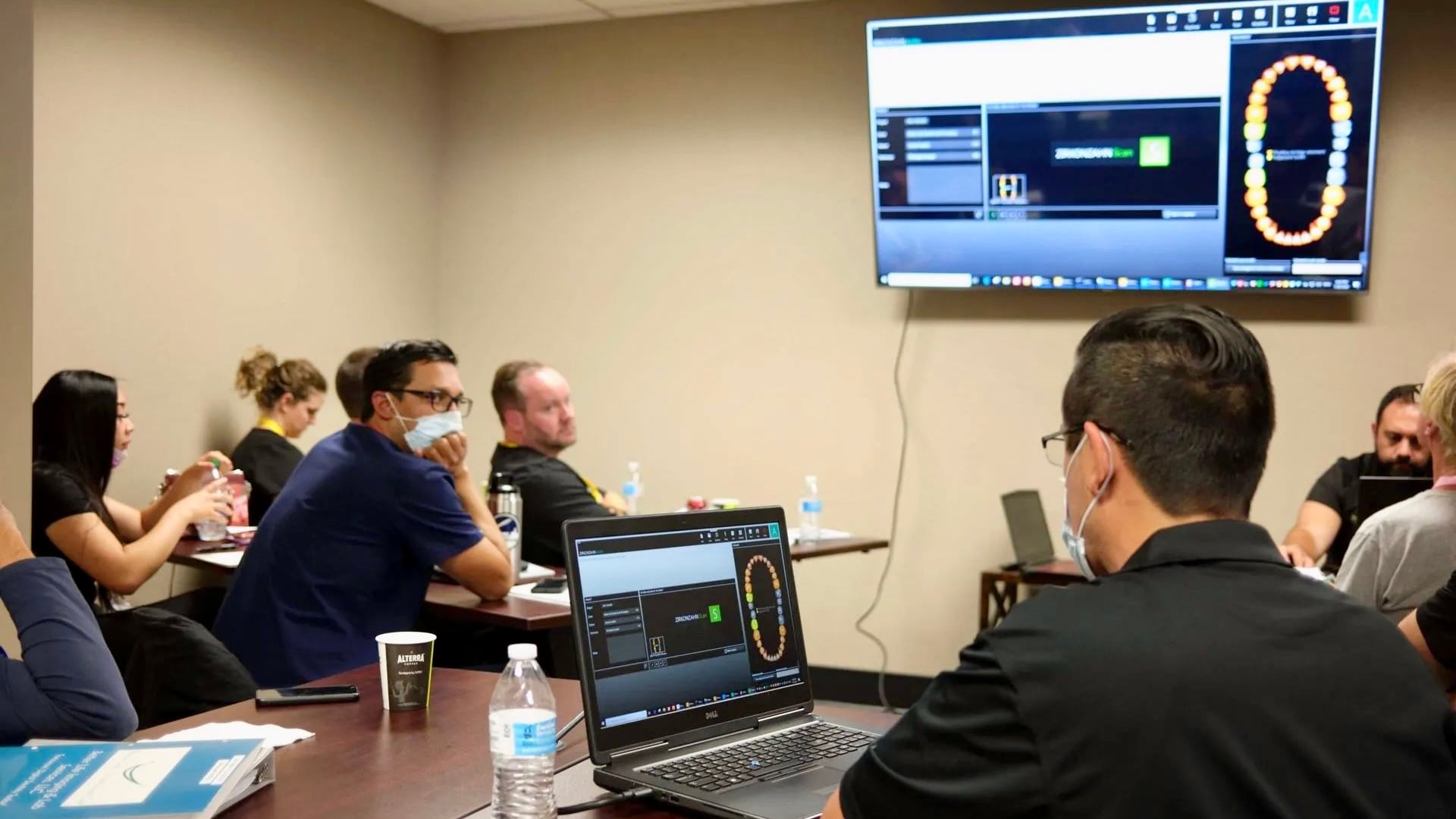
The FAM Method, FAM’s proprietary digital workflow, integrates seven steps into a single repeatable system:
-
Preoperative records and data acquisition
-
Photogrammetry and intraoral scanning
-
CBCT and digital treatment planning
-
exocad design
-
Immediate-load conversion
-
Final zirconia design and finishing
-
FP1-specific design, team implementation, and workflow scaling
FAM courses carry 32 continuing education credits accredited through the American Academy of General Dentistry (AAGD). The full Fellowship program delivers over 90 CE hours. The full-team training model brings the dentist, assistant, treatment coordinator, and lab technician through the same curriculum, so the practice leaves aligned on one workflow and can run it on day one. Alumni join a continued community of hundreds of FAM-trained dentists plus the KOL (Key Opinion Leader) buying group at no recurring cost. That community provides vendor discounts on Neodent implants, exocad licenses, 3D printers, and other equipment.
FAM alumni report adding $1M+ per year in practice revenue after adopting the FAM Method. As Dr. Scott Peters of San Diego put it: “After the 4 days we’ve been here, I feel like I can go home and do full arch.” Dr. Azam Saeed of Chicago added: “We were given the recipe for how to use the tools we have.”
The post-course reality check, the 90-day window where many implant CE programs leave dentists without support, is addressed structurally at FAM through private alumni group chats, peer case review, and a community of hundreds of trained dentists available for case help on demand.
Start Your Implementation Journey
Frequently Asked Questions
How Much Does Dental Implant CE Cost?
Dental implant CE for general dentists ranges from roughly $1,500 for 1–3 day weekend courses to $45,000+ for 12+ month mini-residencies, with continuums (6–18 months) costing $10,000–$30,000. Lecture-only and online programs sit at the lower end of that range. Programs that include live-patient surgical components, small-group instruction, and post-course mentorship sit at the higher end. The relevant comparison is course fee versus the revenue impact of adding independent implant placement to the practice.
What Is the 3/2 Rule for Implant Placement?
The 3/2 rule is a spacing guideline that recommends maintaining approximately 3 mm between two adjacent dental implants and 2 mm between an implant and a natural tooth. The purpose is to preserve the blood supply that keeps bone and gum tissue healthy around the implant. Adequate spacing also supports natural-looking gingival contours, cleanability, and long-term bone stability. The rule functions as a planning heuristic rather than a universal standard. Clinicians should verify spacing digitally on a CBCT scan before surgery and confirm the exact parameters taught by their training program.
What Dental Implant Courses Are Available in 2026?
In 2026, dental implant CE for general dentists is available across three primary formats. Beginner programs include roughly 40 or more hours of didactic training covering anatomy, diagnosis, treatment planning, and model-based placement. Intermediate and advanced programs address GBR, sinus augmentation, immediate load, and full-arch cases. Online and webinar CE supports knowledge development but does not produce independent placement on its own. Live-patient surgical training, the format most directly linked to independent placement, requires a legal framework that varies by state. Dentists evaluating programs in 2026 should verify AGD PACE provider status, confirm their state board’s CE acceptance rules, and ask specifically how many supervised live cases the program includes and what post-course mentorship looks like.
What Is the Difference Between D6056 and D6057?
D6056 and D6057 are both CDT codes for implant abutments, and both include placement in the single code. The distinction is fabrication method. D6056 covers a prefabricated stock abutment selected from the implant manufacturer’s catalog, even if modified chairside. D6057 covers a custom-fabricated abutment designed specifically for the patient from a digital scan or impression and machined or printed to patient-specific parameters such as angulation, emergence profile, and soft tissue contour. Some dental plans apply an alternate-benefit clause that pays D6057 at the D6056 allowable, with the patient responsible for the difference. Documenting the clinical rationale for custom fabrication, including esthetic-zone demands, soft tissue depth, or angulation correction, supports the D6057 designation on audit. General dentists adding implant placement should build a documentation workflow that captures this distinction at the time of charting rather than at the time of a denial.
Do I Need Live-Patient Surgery to Place Implants Independently?
Most general dentists require live-patient surgical experience to reach independent placement. Lecture-only and model-based training build knowledge and procedural familiarity, but they do not develop the clinical judgment required to manage a real case. That judgment includes flap design decisions under variable tissue conditions, osteotomy execution in bone of unpredictable density, primary stability assessment, and complication management in real time. Programs that include supervised live-patient cases tend to produce dentists who place independently. Programs that omit live surgery tend to produce dentists who understand the procedure but hesitate to start. The practical barrier is legal, because most states do not allow visiting dentists to operate on volunteer patients, so live-patient surgical training requires a program that has established the appropriate legal and credentialing framework in advance.
Conclusion and Next Steps
The measure of dental implant CE for general dentists is whether the course produces independent placement and a working system. Hours logged are a poor proxy. Every program should be evaluated against the same six criteria: tier (beginner, intermediate or advanced, or online), AGD PACE approval status, training format (lecture-only, model-based, or live-patient), team attendance, post-course mentorship, and the business layer of coding and billing literacy.
Concrete next steps for any general dentist evaluating implant CE:
-
Audit your current implant case flow and identify implants you restore that you could be placing.
-
Decide whether you are adding placement or scaling it, because that answer determines which tier is the right starting point.
-
Verify AGD PACE provider status for any program you are considering using the AGD PACE provider directory, and confirm your state board’s CE acceptance rules directly.
-
Ask every program the same questions about supervised live cases, post-course mentorship, and whether the curriculum trains the full team or only the dentist.
-
Evaluate the coding and billing layer before the first case, focusing on D6056 versus D6057, D6010, and D6080, because these codes determine whether adding implants improves the practice P&L.
The course that changes a practice produces independent placement, trains the team, and stays present after the last day of instruction. Dentists can hold every program to that standard, including this one.
Start Your Full Arch Masters Training